Thanks Vincent, for the honest advice and feedback.
I appreciate you taking the time to leave the in-depth comments.
I've done alot w/ multiple bracketed exposures and have become very adept at creating natural blends between exposures - however I can clearly see the advantage of using ND grads for this type of photo (esp. w/ film). Hopefully, my experience of manually varying shutter speeds 2-5 stops when creating bracketed composites will give me a headstart when using a kit of graduated neutral density filters.
Again, thanks for the feedback - it is much appreciated,
You do have a very good eye as well as a passion for this craft from what I have seen and read. At this point you really need to look carefully at getting your equipment lined up so that you are no longer limited by your equipment, or lack of it, as with the case here. Just a few little things like this can make a huge difference in the overall level of quality of your work. With better quality, you can then do many more things WITH that work. Hope this helps. Keep up the enthusiasm and passion. Keep following your dreams! Aloha.
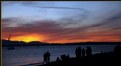
The composition in this scene works for me Chris, but that's about all. This is clearly an instance where you needed to use some kind of graduated filter. A polarizer -as used here- simply reduces the glare throughout the entire image. In this image, you have two very different scenes in terms of lighting. You chose (or perhaps your camera automatically did), to meter on the lower portion; the rocks and ocean. In this case your exposure in that area is good. However, because the sun is close to setting, and because the sun has lit up the sky, and is therefore much brighter than the lower portion, it is subsequently over-exposed or "blown out" completely in my opinion. It looks colorless and somewhat bleached and definitely not very natural. This is exactly why anybody that tries to shoot sunsets prtofessionally uses Neutral Density filters, of which there are many kinds to choose from. The darker upper half of the ND filter would keep the sky position from blowing out while maintaining the light needed to illuminate the detail and the darker rocks in the lower portion. When looking at these two images:
http://www.usefilm.com/image/1085718.html
http://www.usefilm.com/image/1083765.html
I noticed the opposite problem here, though to a lesser degree; that the sky is exposed properly, therefore the natural, rich colors look good, while the lower portions are a bit too dark with very little detail showing.
The very rare case where I have learned I can get away with this issue is well illustrated by this image you took:
http://www.usefilm.com/image/1083765.html
In this case, it is so late in the evening that I have learned you can often get away with using nothing, simply because the lighting evens out before fading away altogether. Though usually this is possible it is not alway the case.
The best type of Neutral density filters system for sunsets and sunrises that I have found is with the Cokin system. Though Lee makes a system as well as Hoya. You simply screw on the mounts (with or without a polarizer) and you can add varying filters as you wish throughout the shoot. You can use up to three at one time even, though I don't recommend it. They also make sunset filters of different strengths that are also colored and graduated; meaning stronger filtration up top than on the bottom, for the reasons already mentioned.
Great mood and soft silky sea. Good composition also. I believe that some sharpness was lost during scanning process, anyway, I think the orig. film was sharper.














 0
0 


 {K:75282} 6/7/2006